
Long term antipsychotic treatment shows diminishing benefits, weak evidence for first episode psychosis, and substantial confounding from withdrawal effects. Psychosocial interventions—particularly Cognitive Behavioral Therapy and Open Dialogue—demonstrate superior functional and recovery outcomes. Current evidence supports shifting from lifelong antipsychotic maintenance toward recovery oriented, medication free or reduced medication approaches. Calling medication-free treatment ideological is not supported by current evidence.
Introduction: An Engineer’s Perspective on Psychiatry
As a graduate in physical engineering, my entire professional life has been anchored in data, systemic analysis, and the rigorous verification of evidence. In engineering, when a system consistently fails or produces severe, unintended side effects, we do not simply double down on the faulty mechanism. We analyze the root cause, re-examine the foundational assumptions, and pivot toward solutions that are empirically proven to work. Unfortunately, when I turned my analytical lens toward modern psychiatry—specifically the treatment of schizophrenia and the widespread reliance on long-term antipsychotic maintenance—I discovered a profound disconnect between clinical dogma and empirical reality.
My journey into this field was not born out of abstract academic curiosity. It was forged through extensive personal exposure to the mental health system in Norway, where I documented severe, systematic violations of patient autonomy and a pervasive reliance on forced medication. These experiences forced me to confront a troubling truth: the very institutions tasked with healing individuals are frequently causing profound, long-lasting harm under the guise of medical necessity. This realization led me to thoroughly investigate the scientific literature, legal frameworks, and international human rights standards surrounding psychiatric care.
Weak evidence for first episode psychosis, and substantial confounding from withdrawal effects
International concern is growing regarding the dominance of the biomedical model in mental health care. The United Nations Special Rapporteur on the right to health has argued that global mental health systems rely excessively on psychotropic medication and insufficiently on psychosocial interventions¹. This critique aligns with emerging evidence questioning the long term effectiveness of antipsychotics and highlighting the benefits of psychosocial approaches²,³.

Antipsychotics reduce relapse rates from 65% to 27% within one year⁴. However, this benefit is strongly time dependent, with meta analytic evidence showing substantial decline after two years⁵,⁶. Long term functional outcomes may even favor discontinuation: a four year randomized controlled trial reported better functioning three years after discontinuation compared to maintenance therapy⁷.
No placebo controlled trials include antipsychotic naïve participants, limiting the validity of conclusions about efficacy in first episode psychosis⁹. Systematic reviews highlight that withdrawal effects in placebo groups compromise the interpretability of existing trials¹⁰. Despite this, antipsychotic prescribing remains nearly universal in some countries, with rates exceeding 97% in first episode psychosis¹¹.
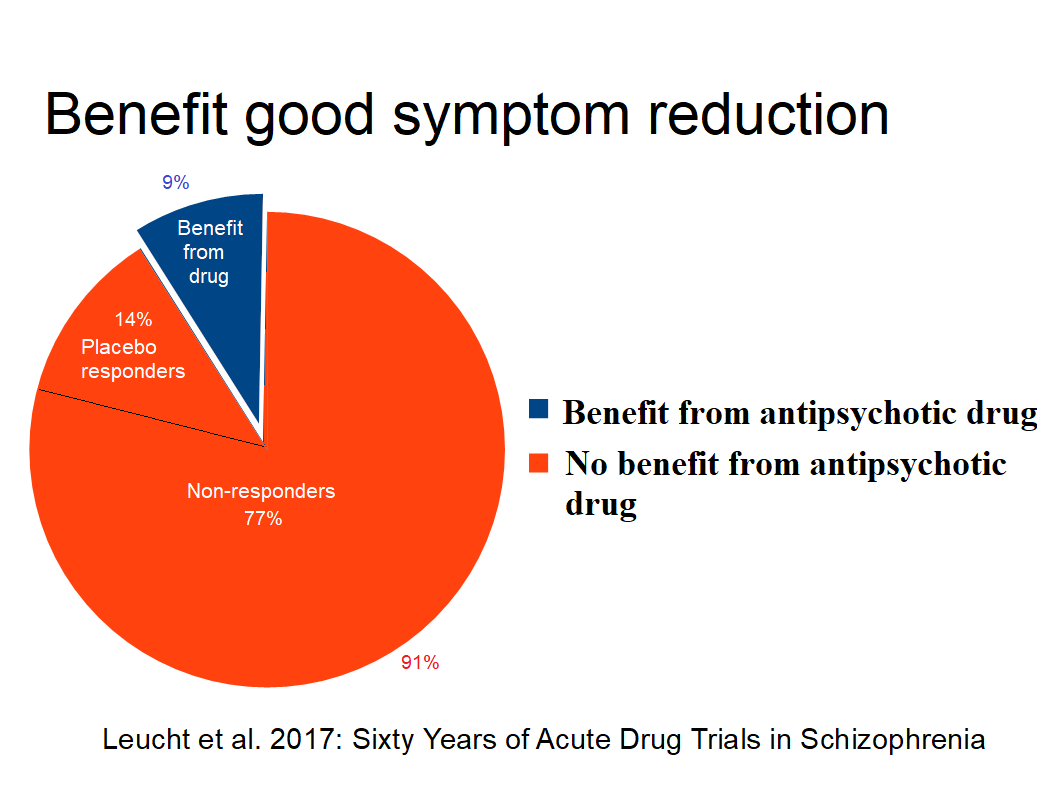
Across sixty years of placebo controlled trials, only 9% of patients achieve a “good response” attributable to antipsychotics¹². The majority do not experience clinically meaningful improvement, raising questions about the centrality of antipsychotics in acute care.
Systematic reviews find no robust evidence supporting long term antipsychotic therapy¹³. The CATIE trial, involving 1,124 participants, reported a 72% discontinuation rate, underscoring tolerability and effectiveness challenges²⁰. These findings suggest that long term pharmacotherapy may not align with patient experience or long term recovery trajectories. The studies of Harrow and Wunderink support tis argument.
Psychosocial interventions—particularly Cognitive Behavioral Therapy and Open Dialogue—demonstrate superior functional and recovery outcomes
Psychosocial interventions—including Cognitive Behavioral Therapy, supportive psychotherapy, and Open Dialogue—demonstrate superior outcomes in symptoms, functioning, and quality of life²,see WHO 2023 (mhGAP) guideline3, and Ranjan, R. et al. 2025¹⁴. Long term observational data from Open Dialogue show substantially lower medication use, reduced disability, and fewer readmissions¹⁵. Despite strong evidence, these interventions remain underutilized due to systemic and cultural barriers¹⁶,¹⁷.

Open Dialogue versus treatment as usual (TAU) for adults presenting in crisis to mental health services in England (the ODDESSI Trial) is a multisite cluster-randomised 2 years trial. Although Open dialogue uses less medication with antipsychotics the time to first relapse was not inferior compared to TAU. Open Dialogue reduced acute inpatient bed use, improved service user reported outcomes and experience, and there were no significant safety concerns
Some authors describe medication free approaches as ideological²¹. However, this framing assumes that antipsychotics are both effective and tolerable long term—conditions not supported by current evidence. A rational, evidence based approach requires reconsidering the default of lifelong medication and expanding access to psychosocial interventions.
The cumulative evidence challenges the assumption that lifelong antipsychotic treatment is necessary or beneficial for most individuals with schizophrenia. Psychosocial interventions demonstrate superior long-term outcomes and align with patient preferences¹⁸,¹⁹. A recovery oriented paradigm emphasizing medication free or reduced medication approaches is warranted and consistent with international calls for reform¹. A shift of paradigm may promote recovery²¹.
References
- Pūras, D. Report of the Special Rapporteur on the right of everyone to the enjoyment of the highest attainable standard of physical and mental health. United Nations Human Rights Council (2017).
- Bighelli, I. et al. Cognitive behavioural therapy for schizophrenia: A systematic review and meta-analysis. Psychol. Med. 48, 1–12 (2018).
- World Health Organization. mhGAP Intervention Guide, Version 3.0. WHO (2023).
- Leucht, S. et al. Antipsychotic drugs versus placebo for relapse prevention in schizophrenia: A systematic review and meta-analysis. Lancet 385, 1376–1384 (2015).
- Ceraso, A. et al. Maintenance treatment with antipsychotic drugs for schizophrenia. Cochrane Database Syst. Rev. 3, CD008016 (2020).
- Leucht, S. et al. Relapse prevention in schizophrenia with new-generation antipsychotics: A systematic review and exploratory meta-analysis. Am. J. Psychiatry 169, 120–129 (2012).
- Schlier, B. et al. Long-term outcomes after antipsychotic discontinuation: A meta-analytic extrapolation. Schizophr. Bull. 49, 1–10 (2023).
- Sommer, I. E. et al. Long-term outcomes after guided antipsychotic discontinuation: A 4-year randomized controlled trial. Psychol. Med. (2025).
- Dalsbø, T. K. et al. Antipsychotics for early psychosis: A systematic review. Norwegian Institute of Public Health (2019).
- Danborg, P. B., Simonsen, S. & Gøtzsche, P. C. Long-term antipsychotic use: A critical review of placebo-controlled trials. Psychother. Psychosom. 88, 1–10 (2019).
- Bergström, T. et al. Real-world antipsychotic prescribing in Finland: A national registry study. Nord. J. Psychiatry 72, 1–8 (2018).
- Leucht, S. et al. Sixty years of placebo-controlled antipsychotic drug trials in acute schizophrenia: Systematic review and meta-analysis. Mol. Psychiatry 22, 1–9 (2017).
- Sohler, N. et al. Weighing the evidence for harm from long-term treatment with antipsychotic medications: A systematic review. Am. J. Orthopsychiatry 85, 1–13 (2015).
- Ranjan, R. et al. Effectiveness of psychological interventions for positive and negative symptoms in schizophrenia: A systematic review and network meta-analysis. Schizophr. Res. (2025).
- Bergström, T., Seikkula, J. et al. The family-oriented open dialogue approach in the treatment of first-episode psychosis: Nineteen-year outcomes. Psychiatry Res. 2018 Dec;270:168-175. doi: 10.1016/j.psychres.2018.09.
039. Epub 2018 Sep 18. PMID: 30253321. - Polese, D. et al. Psychotherapy in treatment-resistant schizophrenia: A 25-year systematic review and exploratory meta-analysis. Schizophr. Res. 210, 1–9 (2019).
- Tandon, R. et al. Psychosocial interventions and functional recovery in schizophrenia—Realizing opportunities today. npj Schizophr. 11, 1–8 (2025).
- McHugh, R. K. et al. Patient preferences for psychological vs. pharmacological treatments. J. Clin. Psychiatry 74, 595–602 (2013).
- Angermeyer, M. C. et al. Public attitudes toward medication-free treatment in psychosis. Soc. Psychiatry Psychiatr. Epidemiol. 52, 1–9 (2017).
- Levine, S. Z. et al. Dropout patterns in the CATIE trial: Implications for long-term antipsychotic treatment. Schizophr. Res. 136, 1–7 (2012).
- Leucht, S., Rodolico, A. Empowering clinicians and patients in antipsychotic dose reduction for schizophrenia: the role of online tools. Schizophr 11, 153 (2025). https://doi.org/10.
1038/s41537-025-00699-7 - Keim, Walter. Paradigm Shift to Promote a Revolution of Treatment of Schizophrenia to Achieve Recovery. Medical Research Archives, [S.l.], v. 11, n. 12, dec. 2023. ISSN 2375-1924. Available at: https://esmed.org/MRA/mra/
article/view/486. https://doi.org/10.18103/mra. v11i12.48666













Not all schizophrenia-like presentations are schizophrenia.
Misdiagnosis and mis-treatment could account for many schizophrenia labels. And, Once charted, labels stick easily, and are almost impossible to refute.
Not all psychosis is indicative of schizophrenia.
Maybe a better medical approach (such as excluding the use of current AI and current algorithms) could lead many people away from mental disorder treatments that are unnecessary and or unwarranted? Practitioners could think beyond the glaring obvious, and check for: physical, metabolic, immune, inflammatory ailments?
Antipsychotics are given readily for many off-label reasons. No psychosis, no schizophrenia required.
Report comment
This is obviously dependent on comprehensive & in depth psychological / social – integral healing approaches being applied. i have heard decades of people being deeply critical of the current biomedical / psychiatric systems & treatments & the supposed superiority of other approaches – however i don’t think that overall picture with schizophrenia is that simple. Genuinely integrated mental health systems incorporate the biomedical / pharma. i’m not sure that we should throw the baby out with the bath water – some people are profoundly disabled with schizophrenia & are helped with a wise use of psychiatry & medication. Personally i think that the evidence points to there being biological, psychological, environmental & soul / Spiritual areas implicated in the psychoses / Schizophrenia (integrated; mind, body, soul, spirit & environment ) & that all areas need to be properly addressed. What would mental health services & treatment of the severely mentally ill look like if everyone came to a compromise & worked together to help this very vulnerable group of people?
Report comment
Problem is, I don’t see the slightest interest in working together coming from the psychiatric field. While judicious use of drugs is something that could be considered (as they do in the Open Dialogue approach), mainstream psychiatry has vehemently attacked any attempt to undermine their unquestioned authority. They give lip service to the “biopsychosocial model,” but in practice, it’s bio-bio-bio regardless of the data telling us that this just makes things worse in the long term.
Report comment
Extreme Anti-psychiatry denies the existence of all mental illnesses & wants to abolish psychiatry / pharma, & i think that is just as bad, wrong & extreme. Within a genuinely comprehensive & integrated / integral / holistic model & approach the biological / biomedical is fully acknowledged – along with the psychological, sociological & spiritual. i also don’t like the denial from a lot of people of the effectiveness for many of Jungian / Depth / Transpersonal psychology & seeing differential elements of the Shamanic / Mystical / Magickal / Alchemical etc in psychotic experience.
i would like to see this –
Integrate a judicious use of front end services / biomedical / clinical psychiatry with comprehensive recovery & healing services – open dialogue / depth psychology / healing homes – with comprehensive integrated / integral health / welfare / social care services & systems. Also integrating the best of traditional / alternative / holistic / integrative / complimentary medicine with the mainstream.
With a shift away from neoliberal Capitalism more towards a Global Socialist / Green Model & Approach & Global Regenerative Culture
Report comment
But you avoided my point. How can there be any “working together” when the mainstream, who hold the power to change, insist on prioritizing their own power and profits over doing what works?
Report comment
i take your point – However if we are specifically focusing Globally on 1 in 100 or 1 in 300 / 400 suffering with severe schizophrenia i think it is highly debatable what it all is & what the best approaches are in dealing with it all? For a start the ways that the mentally ill are treated in different countries around the World varies enormously, & to be fair to international psychiatry – the UN & WHO – it is slowly moving towards far more integrated & integral models & approaches. Not all psychiatrists / psychiatry is the same, & it’s not Planet USA.
It is highly debatable how well all the alternatives work with schizophrenia? Even with a far better society / culture / system & mental health treatment some people i think would still need psychiatry, hospitalization & medication, as part of a comprehensive approach. But then i have suffered a very severe end of psychosis / schizophrenia & seen others who have as well.
Far more research & evidence is needed into all the alternatives.
My experiences of all the available alternatives has been just as bad in ways as front-line NHS services (i’m in the UK).
i think that all areas / camps have issues in this area. Most People are Not Stupid, despite it sometimes appearing otherwise – & there wouldn’t be the controversy with all this if it wasn’t a deeply complex area & question.
Report comment
Psychiatrists in their majority don’t care of other human beings and are living in a paralel world full of arrogance, self-sufficience and self-entitlements fully abusing their position of power.I wonder if any change at all following the Royal College of Psychiatrists published statement of apologies will take any of them a step down from their pedestal where they sit and ruin people lives with their total ignorance and contempt.
Report comment
All said & done i’m all for far more of a focus on comprehensive psychological / social approaches to mental health within an integral paradigm.
How do we get ‘there’?
Report comment
I guess I’m saying that part of “getting there” involves taking the power to define these “illnesses” and their “treatments” away from people whose primary interest is protecting the status quo and thereby their income and power.
Report comment
It’s the same impasse that there has always been – the same divisions / camps & the same arguments / debates that have always existed.
Report comment
So if you want to do what you want to do, how do you propose overcoming these divisions and conflicts of interest? Bottom line, if we don’t get the cooperation of those in authority, no collaboration will ever occur. How do you propose we convince them to let go of their self-interested control and start working with clients as the central focus?
Report comment
As i originally said, i think it needs a compromise from all people / sides / groups / camps / ideologies, & to fully acknowledge the validity of every way of looking at & understanding the human condition / experience. From biomedical & physiological / scientific / Clinical Psychiatric, Neurological, Genetic / Epigenetic (etc) – to the 120 or so different schools of the psychological, to all the areas of sociological & environmental theories, to all the areas exploring the Soul / Spiritual / Transpersonal (The Unification of World Religions / Mythologies & Spirituality [including Atheist / Humanist])- Uniting all areas of the Hard & Soft Sciences; Biological, Psychological, Sociological & Spiritual understandings & approaches – (integrated mind, body, soul, spirit & environment) – i would create some kind of a basic Universal Integral / Holistic Paradigm & Training that ‘Everyone’; has to qualify in before they specialize. i don’t see anyone as being wholly right or wrong in all these areas. It needs a fully individualized highly comprehensive person centered paradigm / model & approach.
Biology, Psychology (Inner World of thoughts, feelings & emotions), Sociology & Environment & the Soul / Spiritual is all a fully integrated Whole.
‘Everyone’ in their own little camps with their own little ideologies / agendas / Beliefs / Grievances etc throwing rocks at each other is solving Absolutely Nothing, it’s like a Game of Thrones.
Sadly i think that my Vision of how i would like things to be will take at least another 200 years before it starts to become a reality.
i have explored all these areas on my own forum / Blog – that anyone is free to contribute to –
https://healingsanctuary.proboards.com/
Put simply i think the answer is within some form of Fully Integrated; Integral / Holistic Paradigm. Getting a working agreement & application however is imo going to take a very long time. In the meantime we can ‘all’ continue with all the conflict, hatreds, war, divisions, environmental destruction & Chaos, as we have been doing for countless thousands of years, to eventual Collective Harmony & Healing or our Collective Demise. i suppose it’s our choice – individually & Collectively. It seems to me that time is running out?
Report comment
Change the laws to protect and be more supportive of those suffering and put a leash on Pharma and the institutions. Clarify by way of the worst psychiatric outcomes.
Showcase other non-medical possibilities and allocate funding for land and people to utilize for recovery. (Take this funding from the coffers of the war mongers.)
Not one has ever been born pharmaceutically deficient.
Report comment
After years of working in community based intervention programs such as intensive case management and group homes I appreciate the power of psychosocial treatment, but as long as these relatively expensive services are not funded by the US health care system, medications remain our only alternative.
Report comment
There are all the questions as well as to what to do with all the millions of people already highly dependent on these medications? i’ve been medicated for 36 years – it’s Not simple or easy to withdraw from these drugs, even if there was all the understanding, help & support in the World.
Report comment
If you’re given alternatives within a system, how much choice or freedom do you have at all if you’re still bound by the system’s rule(s) of reality? A paradigm shift of treatment within a medical industry that monopolizes and manipulates health care for profit over people amounts to no more than bizzness as usual.
In this and virtually every other issue of MIA, reports of new studies further confirming how medicine is harmful to human health, and routinely lethal, are repeatedly published. What is the purpose of such research beyond legitimating illusion that organized crime of the pharmafia and other ruling class corporate partners somehow, sometime in some distant fulture, might, just might reform itself for the sake of people who are systemically treated as no more than monetary units on spreadsheets, who have no intrinsic value beyond their instrumental value as a means of exploitation by and for the predatory parasites who live off our labor and lives in the rotten system of crapitalism?
The paradigm shift required goes beyond symptomatic treament to strike at the underlying cause(s) of a social system that subjects people to profit. Revolution at the roots of established reality of rule in favor of egalitarian relations is a choice we make to escape the prison of power.
Report comment
i can see & understand that Perspective John – However, can we ever get humanity to agree on what kind of society / system / mental health system / treatment it wants? & all the anti / critical / alternative points of view considered – the psychoses / neuroses / PD’s are as old as recorded history & humanity. i went through 8 years of very severe psychosis, i think a lot of it all was biological & the medication works. It’s totally hypothetical as to whether the alternatives would have worked in my case, & what alternatives i tried didn’t work. Would i have gone through all that i did within a far better society / system? i think it’s highly debatable. i think that mental health is dealing with massively complex & in depth areas.
Yes, maybe for the vast majority of people they are not severely mentally ill, could be far better helped & don’t need psychiatry, hospital & medications. & wouldn’t have the problems that they have in a better society / system – However i’m not sure that applies to everyone?
The 1% or so of the population suffering schizophrenia i think do present a conundrum that is Not easy to resolve.
Report comment
As James Carville said “It’s the economy stupid.” The bottom line is that if businesses always and truly put people over profits, it gets pretty hopeless that they would meet their bottom line. It’s pretty hard to have an economy without some kind of zero sum thinking or at least a situation where some have more and others less. A money free Utopia would be great but I don’t think humanity is ready for that yet.
Psychiatry is about power and profits. Deception and lies are just a necessary evil to ensure that the financial gravy train gets a smooth ride. When you realize that psychiatric “mental health” is just a red herring as PR to make the affluent and powerful feel good about and continue their dirty deeds done dirt cheap, you realize that there is nothing really wrong with psychiatry. Psychiatry is working just fine as intended, as it always has and always will. The solution to all this is some kind of massive wide scale financial power debasement or (probably forced) economic abdication or destruction. When the host dies, the parasites have to look somewhere else to feed. As long as there is gold in them there ills(Niall “Jock” McLarin), those looking for the mother load will just keep panning and mining. I don’t think that things like Open Dialogue or Soteria houses can work very well in the Pharma cash cow of the world(US), until something incredibly financially crippling or de-incentivizing happens to the psycho-pharmaceutical industry in America which by hook or by crook has the financial power and incentive to keep those kinds of programs under wraps (financially crippling situations such as like ending Pharmaceutical direct to consumer advertising or successful lawsuits by harmed patients against psychiatrists or capital punishment/serious prison time for Pharma executives). However, I don’t think US greed and ego will give up their “precious” (Lord of the Rings) so long as the American golden age continues. America’s savior may be its greatest financial nightmare-BRICS. Sometimes an outside threat or a common challenge can unite people to a solution that requires cooperation. However in North Korea, that kind of thinking seems to aid the ends of dictatorial propaganda. I guess for now, I don’t think I really know what the solution will be. Somehow in all this I am reminded of a song.
https://m.youtube.com/watch?v=CGj85pVzRJs&ra=m
Report comment
Without a Post Capitalist Future – Along the Lines of a Global Solar Punk / Eco-Socialist / Pagan Anaracho Communist / Zeitgeist Movement / Venus Project / New Earth Nation – Global Regenerative / Permaculture Culture etc – within comprehensive health & social approaches; like open dialogue, depth psychology, healing homes, mutual aid etc as standard, i think that our days are numbered – i don’t think that humanity is going to survive – at least this ‘civilization’ isn’t going to survive beyond 2030 to 2050.
Report comment