
“FND occurs when the brain has difficulty sending and receiving signals properly, even though scans like MRI or CT appear normal. It affects movement, sensation, speech, cognition, and other functions. Symptoms are genuine, involuntary, and can be disabling.”
—NIH website
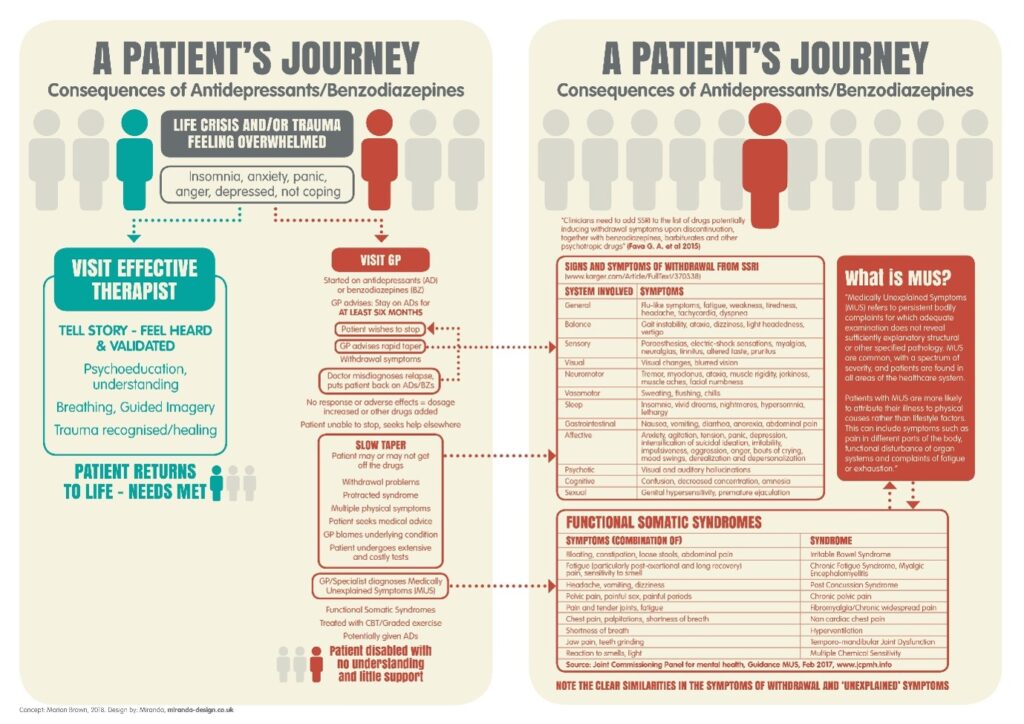
More and more people are being diagnosed with ‘functional neurological disorder’ (FND). FND is essentially a term for ‘unexplained’ symptoms—including severely disabling symptoms such as movement disorders, blackouts and so-called ‘non-epileptic seizures’—and which doctors say has no clear cause. I began to notice about 10 years ago that these ‘unexplained’ symptoms were the same symptoms as those experienced by some people when taking prescribed drugs for ‘depression’, ‘anxiety’, ‘stress’, etc. and especially when trying to reduce or come off these psychiatric drugs.
I began to meet more and more people with the FND diagnosis who were also experiencing withdrawal effects after stopping antidepressants, benzodiazepines, and other psychiatric drugs—but no doctors seemed to connect the two. I have now come to think that the diagnosis of FND is essentially a way to dismiss adverse effects and withdrawal symptoms—so that doctors can continue to say that psychiatric drugs have no such effects because these effects are diagnosed as something else, even while admitting that they can’t explain what that something else is.

Background
I had trained over some years and became qualified as a Human Givens Practitioner in 2011, and subsequently worked as a private Human Givens practitioner/psychotherapist in Helensburgh, Scotland. This work brought me into contact with many people who, it turned out, were struggling with the effects of having taken medicines prescribed usually by their primary care physician for ‘depression’, ‘anxiety’, ‘insomnia’ etc. This led on to the co-founding of a local ‘motley-crew’ patient self-help group, Recovery and Renewal, in 2013.
Initially we met locally to offer companionship and free non-drug wellness support—and also to ask collectively for formal National Health Service (NHS) support for people who were struggling with adverse and withdrawal effects of these very commonly prescribed drugs. Our efforts were mostly met with fobbing off by local GPs and by official NHS and Scottish Health service bodies.
My lay-person research campaign began as an attempt to formally raise concerns with prescribers about the apparently overlooked adverse and withdrawal effects of antidepressants and benzodiazepines—which were and are (especially antidepressants) commonly prescribed in primary care settings. People who had come together through our Recovery and Renewal group (which later become a wide-reaching Facebook Group), were (and are) fellow researchers and campaigners. We are now mainly active on X @recover2renew.
Questioning ‘Unexplained Symptoms’
We began questioning the diagnosis of Medically Unexplained Symptoms (MUS) and Functional Neurological Disorders (FND) in 2016—as it was apparent by then that these mysterious disabling conditions (of ‘unknown aetiology’) were appearing in people’s medical records and that these ‘conditions’ (listed in the DSM) clearly shared many symptoms with antidepressant (and benzodiazepine) side effects and/or withdrawal effects.
I came across a book, ABC of Medically Unexplained Symptoms (2013) and was startled to find chapters written by the (now internationally well-known) FND ‘experts’ Jon Stone and Alan Carson in Scotland—chapters in particular which seemed to refer to the very symptoms that people were experiencing as a consequence of taking (and/or trying to withdraw from) antidepressants & benzodiazepines.
Being also based in Scotland, this was particularly pertinent to the people in our local group, with Stone and Carson having close connections with (and funding from) the Scottish Government and Scotland’s National Health Service. It became apparent that ‘Medically Unexplained Symptoms’ (a DSM diagnosis) seemed to be becoming more often diagnosed as ‘Functional Neurological Symptoms’ (FND).
My own first article was published by Mad in America in December 2016: “An Outsider’s Observation: Medically Unexplained Somatic Symptoms in General Practice”:
“The GPs, having to comply with their professional guidelines and ‘best practice’, become frustrated when the patients keep coming back with various ‘functional’, ‘somatic’ or ‘Medically Unexplained Symptoms’ (MUS) for which tests are carried out until it is established that there is ‘no physical cause’ — so the GP then, again following professional guidelines, tries to ‘reassure’ the patient that there is ‘no disease’ and that CBT and exercise – and perhaps ‘acceptance’ and ‘re-attribution’ therapies are what is needed.”
From early 2017 I and others wrote to Jon Stone raising our concerns, in particular about antidepressants and benzodiazepines. He answered initially and then stated that he could not communicate further with us.
Our Parliamentary Petitions—Scotland and Wales
In mid-2017 we launched our Scottish Petition, where I am the ‘named Petitioner on behalf of Recovery and Renewal’.
“If it cannot be acknowledged that patients can have sustained functional nervous system dysfunction and damage as a consequence of taking medicines ‘as prescribed’ (and sometimes over many years), systemic medical learning and improvement is stifled and patients continue to be further harmed. Meanwhile, the initial prescribing risks remain severely underestimated and misleading prescribing guidelines and ‘best practice’ advice persist unchanged.”
It so happened that also in mid-2017 Jon Stone and Alan Carson were awarded the President’s Medal by the then president of the Royal College of Psychiatrists, Simon Wessely, and later that year Stone and Carson co-chaired a landmark international conference in Edinburgh on FND.
Meanwhile our Scottish and Welsh Petitions made their way slowly through respectively the Scottish & Welsh Parliamentary petition processes, the Scottish Petition being eventually closed in March 2021. This was a gruelling and time-consuming process and seemed to drag on forever (especially in Scotland). The evidence is all there—archived on Scottish Government website. Of course, it was all eventually effectively ‘buried’.
We had also been working with the British Medical Association (BMA) Board of Science, as further detailed in a BMJ article:
“As explained in the ‘petition background’, we had previously already attempted to engage collaboratively with the medical profession and politicians. We have been involved with the British Medical Association (BMA) Board of Science project working on this issue since early 2014. Our Petition calls for recognition of the BMA published findings, 2015 (4) and BMA call for action, October 2016 and updated (5).
We are invited to participate in the BMA Board of Science round-table stakeholder meeting scheduled for 18 April 2018”
“…the evidence’ of prescribed harm is being actively attributed to vague psychiatric diagnoses such as ‘medically unexplained’, ‘functional’ and ‘somatic’ disorders. Patients suffering complex, serious and disabling symptoms – from prescribed drug damage and neurotoxicity – are being directed to websites such as http://www.neurosymptoms.org/ and encouraged to engage in (perhaps online) Cognitive Behavioural Therapy (CBT) and acceptance of their mysteriously acquired disability.”
In 2018 with the help of James Moore (well-known now to Mad in America!) and his wife Miranda we put together an Infographic about what seemed to be happening to so many people—and this was shared on social media and through a Human Givens Institute article where Moore shared his own experience:
Formal Journal Publication
In 2020 we formally published in the Sage journal Therapeutic Advances in Psychopharmacology a collated summary of the very extensive raw patient-experience evidence which our Scottish and Welsh public petitions had gathered. This showed clearly the ‘patient journey’ accounts, where previously well people had been rendered extremely unwell—or had died—as a consequence of taking antidepressants and benzodiazepines, etc. ‘as prescribed’, and sometimes over long periods of many years:
Stevie Lewis (IIPDW Board member), Welsh petitioner and a co-author of the above paper and other published ‘patient experience’ work, developed a severe movement disorder due to SSRI withdrawal and was diagnosed with FND. She wrote this blog for Rxisk in 2020: “My Doctor thinks I’m Faking It; SSRI Movement Disorders”. Many other people are getting this FND diagnosis; in our own ‘patient research group’ this also included Alyne Duthie, Fiona French, Sharron Hudson—and we are hearing of countless others daily.
Mad in America picked up another two articles that we had written, “Antidepressant Withdrawal Misdiagnosed as Functional Disorder” and by Stevie Lewis, “Four Essential Studies on Antidepressant Withdrawal Every Prescriber Must Read”.
Of course, the Covid pandemic added more layers of complication—with ‘Covid-anxiety’ having resulted in a huge surge of the prescribing of drugs for ‘anxiety’ and ‘depression’, etc. Further increases in prescribing then followed for Covid vaccine-related issues and Long Covid.
We have continued throughout to try to raise concerns, via the proper channels such as writing to the British Medical Journal (BMJ) and British Journal of General Practice (BJGP). For example:
‘Grosset wrote in 2004 “Prescribed drugs and neurological complications”, concluding that “A wide spectrum of neurological presentations may be caused or precipitated by drugs, prescribed and non-prescribed. Doctors have a responsibility in preventing iatrogenic symptoms by careful prescribing, and in identifying drug induced syndromes”’.
In 2024 Horowitz and Taylor published the Maudsley Deprescribing Guidelines—and our 2020 Guy et al. ‘Patient Voice’ paper is cited throughout:
“There are numerous overlapping symptoms of psychiatric drug withdrawal with these conditions: tremor, weakness (functional neurological disorder); fatigue, tiredness (chronic fatigue syndrome) and numerous symptoms that could be grouped under the category of ‘medically unexplained symptoms’ when the symptoms are not attributed to psychiatric drug withdrawal. These misdiagnoses can lead to a failure to recommend appropriate treatment, extensive medical investigation and a feeling on behalf of patients that they were not listened to”.
The Response?
It has become abundantly clear that, from the very outset, the alarms we were and are raising are perceived as unwanted and controversial to the mainstream medical ‘view’—and to be ignored or suppressed. There continues to this day to be very strong pushback academically and on social media, and the press is very wary of ‘going there’. Meanwhile the FND bandwagon has been gathering pace and gaining ever wider global following and support, with the international FND Society having been being founded in 2018 following the 2017 Edinburgh Conference and having recently held a sixth International Conference in Baltimore.
Two recent papers, both co-authored by Jon Stone and Timothy Nicholson (neuropsychiatrist, London) and others, are especially troubling. In particular, neither of these papers appear give any proper attention to the effects of medicines widely and commonly prescribed for FND ‘co-morbidities’—the very drugs that also cause these symptoms.
Fundraising charities such as FND Hope International and FND Action UK have Jon Stone, Timothy Nicholson, and other well-known FND ‘experts’ as trustees and/or on their medical advisory boards.
Several of us wrote to Jon Stone at various times about the concerning ‘medication’ information on his website—especially regarding antidepressants and antidepressant withdrawal:
“With some types of antidepressants, there may sometimes be symptoms when the tablet is stopped. If this happens these withdrawal symptoms are usually over within a week or so.”
He eventually added the second sentence below after the Royal College of Psychiatrists recognised antidepressant withdrawal in 2020:
“Some patients report longer duration symptoms triggered by this withdrawal syndrome or the medication themselves.”
Where are we now?
Now in 2026 there are many Facebook Groups and other peer support groups set up by people who are diagnosed with FND, as well as the charities (FND Hope, FND Action, FND Society etc) ‘raising awareness of and funding for FND research’. FND is increasingly ‘in the news’.
In January 2026 I submitted the submission below to the Scottish Parliament Petition Committee in response to Petition PE2165.
My submission includes:
“The fact that more and more people in Scotland are being diagnosed with FND is clear proof that something is going very seriously wrong. GPs and other HCPs are being actively taught to miss—and mis-diagnose as FND—the most important signals which should alert them to considering possible adverse effects of these commonly prescribed ‘safe and effective’ [sic] drugs which they are continuing to start new people on every single day—as well as recommending risky too-fast tapering, switching, adding more drugs, and other interventions which can and do exacerbate the wide-ranging adverse drug effects being suffered by patients.”
“Please would the Petition Committee take appropriate action now to convey to the Scottish Government that many people are becoming harmed—and urge that the adverse effects of commonly prescribed antidepressants etc. no longer be missed and mis-diagnosed as FND.”
With the alarming rise and rise of prescriptions of stimulants and antidepressants for ADHD (Attention Deficit Hyperactivity Disorder) also becoming apparent, perhaps this is no surprise either, from ‘Prevalence of ADHD in FND’:
“Approximately one in six individuals with FND also meet criteria for ADHD, with particularly elevated rates observed in functional tic-like presentations and in children and adolescents.”
Conclusion and questions
We have to wonder what is going on here. Is prescribed harm being hidden within FND diagnoses? And more and more of it? (And, whilst my own focus has been on drugs prescribed for ‘mental health’, what of the iatrogenic harms of other prescribed drugs and medical procedures?)
All the calls are for more funding for FND research, and FND patients are being encouraged to run the FND Charities and encouraged to ‘raise awareness of FND and raise funding for FND research’.
Meanwhile… ever more people are being put at risk via ‘prescribing guidance’ for prior and later-developing ‘co-morbidities’ of FND. This is very deeply concerning. There is NO FOCUS WHATSOEVER on what might be leading to more and more people suffering seriously debilitating ‘co-morbidities’ and neurological damage. And there is no sign of any attempts to stem the soaring prescribing of these essentially toxic drugs, leading on to serious disabling consequences.













Thank you for this invaluable and important further advocacy Marion.
Predictable iatrogenesis: ‘Patient disabled with no understanding and little support’.
For example:
Inappropriately prescribed SSRIs/SNRIs/ADs for minor, self-limiting, life stresses.
Rapid Adverse Reaction — AKATHISIA. Misdiagnosed as ‘Bipolar Disorder’.
Unlawful detention – forced psychotropic ‘medication’ —–> Increased AKATHISIA intensity.
Multiple additional ADRs —> Cascade of “psychiatric co-morbidities”.
Series of Labels for Life, each with additional psychotropic drugs, and further, multiple systemic, social and emotional injuries.
Lifelong injuries, societal rejection. New physical illness immediately assumed to be
‘Mental Health’ aetiology. Withdrawal suffering unrecognised and misdiagnosed.
Is this acceptable as 21st Century, ‘Evidence Based Medicine’?
We seem to have Evidence Debased Medicine?
It appears self evident that prescribed harm is being hidden.
Report comment
Individuals directly harmed by incompetent medical professionals—a form of clinical iatrogenesis (Illich, 1976)—should not be relabelled with further derogatory disorders. What we are experiencing is iatrogenic neurotoxicity. Because psychiatric drugs alter and disrupt the structure and functioning of nerve cells, they are neurotoxic (Breggin, 2018). Neurotoxins cause a host of physical and cognitive symptoms, including pain, fatigue, headaches, loss of appetite, balance and coordination problems, memory loss, and cognitive impairment. In some cases, neurological function is not recovered (Cleveland Clinic, 2024). Therefore, functional neurological disorder is a misnomer; these known adverse effects are directly attributable to the medically negligent prescription of neurotoxins.
Report comment
I agree with this criticism.
My only wonder is whether the dissident people in the “mental health” professions will ever break away and start organizing and advocating around theories and therapies that really work. As long as mainstream psychiatry and psychology are the only shows in town, the public will go underserved, which is to say, harmed by drugs they really don’t need.
Report comment
If anyone suspects an adverse drug reaction they should report it using established systems, in UK this is the MHRA “yellow card” . Patients, carers and parents can report, not just health care professionals.
In my view, this is the best way to build up clinical information and knowledge, which can then be used to inform prescribers. In my view this is the only way to properly link FND to use of any prescribed drug.
Report comment
This is the first clear explanation of what happened to me.
Report comment
As Marion describes in her excellent article above, I am a co-author with her on the subject of FND and I have a diagnosis of FND. I developed a movement disorder which is described as “functional” in my medical records because all tests and scans are “normal”.
17 years on the SSRI Seroxat/Paxil don’t seem to be considered by neurology as a reason why I lose control of my body – I have episodes of involuntary muscular jerking which leave me in pain and feeling ill for days. The cause of my problem is deemed to be my “anxiety”. The logic flowing from that is that through my “mood” I have damaged myself neurologically.
When I look at the situation with FND, I see a parallel with how things were with antidepressants 20 years or so ago: an expansion of uses for the drug, more funding for research, positive social media influencing, a determination to remove stigma and accuse naysayers of stigmatising. This should be a positive thing for people with FND, shouldn’t it, an expansion of understanding and reduction in stigmatising? But it seems not if you believe the cause of your movement disorder is due to drug adverse effects. It seems neurologists do not acknowledge that possibility.
I find it hard to understand why not. Can they really be so ignorant of the effects of a range of drugs which were designed to alter the functioning of the brain and the nervous system, the very areas of the so-called expertise of their profession? Or we come back to wilful blindness, exactly where we were with antidepressant dependence and withdrawal 20 years or so ago.
Report comment
I have posted the comment below on these two posts on FNDNope:
https://fndnope.org/posts?postId=1821
https://fndnope.org/posts?postId=1865
My comment:
My name is Peter Scott-Gordon. I am a retired NHS psychiatrist who practised in Scotland for 25 years until my retirement several years ago. It so happens that I am also one of those who has personally experienced withdrawal symptoms when attempting to stop an SSRI that I was prescribed several decades ago for anxiety, stress and insomnia.
While FND may have clinical validity in specific contexts, its misapplication to symptoms which may be caused by prescribed drugs is neither scientifically sound nor ethically defensible.
Given how heavily the modern FND framework has been championed from right here in Scotland, those of us within Scottish medicine have a particular moral responsibility to speak up when we see this potential risk: misinterpreting iatrogenic harm as a functional disorder obscures the true cause. It also prevents affected patients from receiving safe, informed deprescribing support. I would urge the FND leads, such as Professor Jon Stone and Professor Alan Carson, to openly respond to the legitimate concerns being raised here.
I would like to put on record my appreciation of the campaigning on this subject, over many years, by Marion Brown. I would also like to commend Christoff Truter for the clarity and balance of the considerations made in this post.
Report comment
Excellent essay, thank you very, very much!
I think of Captain Jack Sparrow’s compass, and of my own…spinning.
I think of a line from another movie, “When you stray from your path, you lose your power.”
And, from “The Last Samurai:”
“You think a man can change his destiny?”
“I think a man does what he can, until his destiny is revealed.”
Cosmically, divinely, I don’t believe we can actually ever truly stray from our path, or err, but I do believe that a part of us knows when we are not choosing our path, as Chesterton wrote that Joan of Arc did, and going “down it like a thunderbolt.”
I think our “subconscious mind” can create the most magnificent migraines, the most scintillatingly excruciating neuralgias, the most heartbreakingly agonizing costochondritis…and so many more sensations and conditions called psychological or psychosomatic or psychogenic or neuroplastic and sometimes said to have “psychological rather than biological or organic causes,” almost as though our psyches did not exist or were not natural or real or were imaginary, or as though are very imaginations, themselves, were not our very essence, and the very Awareness into which this big bang, like all the others, expands!
“Imagination is more important than knowledge. Knowledge is limited. Imagination encircles the world.” – Einstein, published in 1929.
“Imagination is more important than knowledge. For knowledge is limited, whereas imagination embraces the entire world, stimulating progress, giving birth to evolution. It is, strictly speaking, a real factor in scientific research.” – Einstein, published in 1931.
https://youtu.be/qINdA6E14Sk?is=wfhinc95sCeZBo2n
Conversion disorder – Wikipedia https://share.google/gMfnjuUpUueP3AcJC
Sickness behavior – Wikipedia https://share.google/1UDJzbP7sNvd82sbi
“It is only with the heart that one can see rightly; what is essential is invisible to the eye.”
Antoine de Saint-Exupéry, “The Little Prince.”
But what unique essence can we not perceive when we look into the eyes of another?
How can genetically identical twins sometimes be such different people? Entirely different souls?
No matter how difficult life may get, or how much one may wish one had never been born, why do we – or some of us – never wish we were someone else?
When we read lines like
“Certainty of death; small chance of success: WHAT are we waiting for?,”
or
“I shall pass through this world but once. Any good, therefore, that I can do or any kindness that I can show to any human being, let me do it now. Let me not defer or neglect it, for I shall not pass this way again,”
or
“We come here only to help one another,”
or
“The meaning of life is to help others find their meaning of life,”
or
“The meaning of life? The lessons get harder until we GET them!,”
or
“I know exactly where I am: I was lost here before!,’
or
“The meaning of life is that you can have anything and everything you desire as soon as and as long as you don’t WANT it [but where desiring and wanting as in feeling lack are not the same],”
or
“You do not become good by trying to be good, but by finding the goodness that is already within you, and allowing that goodness to emerge. But it can only emerge if something fundamental changes in your state of consciousness,”
or
“Out beyond ideas of wrongdoing and rightdoing,
There is a field. I’ll meet you there.
When the soul lies down in that grass,
The world is too full to talk about.
Ideas, language, even the phrase each other
Doesn’t make any sense,”
“Nothing real can be threatened. Nothing unreal exists. Herein lies the peace of God,”
or
“The peace of God, which passes all understanding ,”
or
“Our deepest fear is not that we are inadequate. Our deepest fear is that we are powerful beyond measure. It is our light, not our darkness that most frightens us. We ask ourselves, ‘Who am I to be brilliant, gorgeous, talented, fabulous?’ Actually, who are you not to be? You are a child of God. Your playing small does not serve the world. There is nothing enlightened about shrinking so that other people won’t feel insecure around you. We are all meant to shine, as children do. We were born to make manifest the glory of God that is within us. It’s not just in some of us; it’s in everyone. And as we let our own light shine, we unconsciously give other people permission to do the same. As we are liberated from our own fear, our presence automatically liberates others,”
or
“Beyond a wholesome discipline, be gentle with yourself. You are a child of the universe no less than the trees and the stars; you have a right to be here,”
or
“If this world were perfect, it wouldn’t be,”
or
“When you come to fork in the road, take it,”
or
“…for we are all as God made us, and many of us much worse,”
or
“…for there is nothing either good or bad,
But thinking makes it so,”
or
“…and no ambassador would ever be relieved,’
or
“…the Kingdom of God is within you,”
or
“Try to accept each moment as though you had chosen it,”
or
“There is no coming to consciousness without pain,”
or
“I think a person does what they can…until their destiny is revealed to them,”
or
“No one chooses evil because it is evil; they only mistake it for happiness, the good they seek,”
or
“Forgive them, for they KNOW not what they do!,”
or
“Your ‘sins’ are FORE-given you!” (that phrase which, so uttered with such conviction – as in three canonical gospels, I believe – may be understood to have very naturally, rather than supernaturally, been quite enough to instantly heal one victim of “FND,” “FNSD,” “a Conversion disorder” or fibromyalgia, or CFS or “ME”),
or
“Enlightenment is the end of suffering,”
or
“Know the not that ye are gods!,”
or
“What are men? Mortal gods.
What are gods? Immortal men!,”
or
“In all chaos there is a cosmos; in all disorder, a secret order,”
or
“If I were you, I wouldn’t start from here, at all,”
perhaps what recognizes any ultimate, deep truth is that very same which can produce “FND,” “FNSD” – until we understand that this is no disorder, but order, no chaos, but cosmos…and perhaps it is what leaves us dangle as hapless victims of our every fleeting feeling of fun or of frustration – at least until it is all fun, or Zen, or Self-realization, or “on Earth as it is in Heaven?”
And perhaps a human being is both mortal human AND immortal being/psyche/soul/spirit/consciousness?
And perhaps the hum- is our sense of humor, our psyche’s higher levels of awareness, and the -an our purely animal nature?
And perhaps our FEAR, father of our every malice, malaise, malingering and malignancy, in all its many unmerry manifestations, is merely False Evidence (or Expectations) Appearing Real, and perhaps this is why and how Love can heal all?
And when we go through our cycles of low and of high energy, of health and of illness, maybe we can accept and honor them…and so transcend them?
Thanks, again, for the wonderful essay!
Comfort and JOY!
Tom.
Report comment